


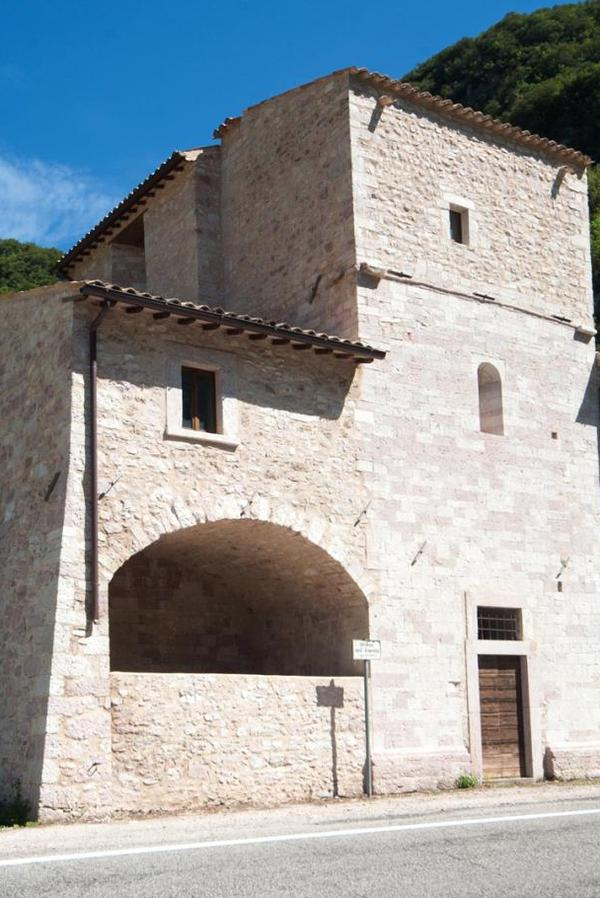
The Abbey is located on the main road of Valnerina along the course of the Nera river, in a place called dell’Eremita, a name derived from the presence of various hermit caves found on the walls of the rocky amphitheater behind the complex of buildings.
These were built on the foundations of an earlier church connected to the monastery of Santa Maria de Ugonis, which the Benedictines of the monastery of Sant’Eutizio transformed into an abbey in the 9th century. From the 11th century until 1654, it was granted to the Vallombrosan monks.
The current name of the church is Madonna dell’Eremita and it includes a Greek cross crypt dating back to the 11th century, which can only be accessed from the road.
The structure is architecturally atypical and, although partly in ruins, allows one to imagine the complexity of the original building.
In the Middle Ages, the place was known throughout Europe and praised by the charlatans of Cerreto as a holy site for which they collected offerings to have masses celebrated there.
The interior consists of a single nave connected to a small chapel. Of the main structure, only the side walls remain, and the space has over time been largely occupied by the chapels of the adjacent cemetery, while the base is partly buried, also blocking the stairs leading to the crypt.
The Romanesque portal of the church now serves as the entrance to the cemetery and was originally the only access to the building, oriented toward the mountain, while inside one can see the remains of the original decorations, unfortunately repeatedly plundered between the 15th and 17th centuries.
The apse has a barrel vault with traces of 14th-century frescoes.
In 1974, a 12th-century wooden Madonna was stolen from the church, later recovered and now preserved in the village of Piedipaterno, along with a triptych by the Master of Eggi dated 1451. In the 1970s, part of the nave and transept were restored, and one can admire frescoes by the Master of Eggi and others from the 15th, 16th, and 17th centuries.

Why is Castello di Postignano called a “gateway to the Valnerina”?
Because the village is the ideal starting point for discovering one of Umbria’s most authentic, unspoilt areas. From here you can enjoy experiences that combine nature, culture, tradition and encounters with local communities.
How can I arrange local experiences?
Our reception team is on hand to suggest activities, check availability, and put together experiences tailored to your interests.
Are the activities run directly by Castello di Postignano?
Some take place within the village; others are organised with selected local partners who share our commitment to the development of the area.
Can I book private experiences?
Yes — many activities can be arranged privately or for small groups, subject to availability.Sì. Molte attività possono essere organizzate in formula privata o per piccoli gruppi, previa disponibilità.
What gastronomic experiences can I enjoy during my stay?
The Valnerina is a land of culinary excellence. We organise tours and tastings with wineries, farms, saffron producers, beekeepers and local artisans.
Can I visit wineries and taste Umbrian wines?
Yes — we can arrange guided tours of some of the region’s most interesting wineries, with tastings of wine and local products.
Can I meet local producers?
Absolutely. One of our most popular experiences is meeting producers of honey, saffron, wild herbs, olive oil and other local delicacies in person.
Do you organise craft beer tastings?
Yes — on request, you can take part in tastings of Umbrian craft beers paired with local produce.
Can I go truffle hunting?
Yes. We organise truffle hunts with local guides and trained dogs, often paired with a visit to the Scheggino Truffle Museum.
What sporting activities are available nearby?
The Valnerina offers plenty for outdoor enthusiasts: hiking, mountain biking, e-biking, rafting, nature walks and guided excursions.
Can I rent electric bikes?
Yes — e-bikes can be hired in the village so you can explore the area independently.
What is the Spoleto–Norcia Greenway?
One of Italy’s most scenic cycling routes, built along the historic Spoleto–Norcia railway, passing bridges, tunnels and striking views.
Can I go rafting?
Yes — we organise rafting on the Nera River and near the Marmore waterfalls, suitable for beginners and more experienced rafters alike.
Which villages do you recommend visiting?
Among our guests’ favourite destinations are Rasiglia, Vallo di Nera, Scheggino, Norcia, and the many small villages of the Valnerina, rich in history and tradition.
Which lesser-known places are worth a visit?
Pupaggi Castle, the Church of San Martino, and numerous small historic centres, preserving frescoes, artistic treasures and corners still largely untouched by mass tourism.
When can I see the Castelluccio Flower Festival?
It generally takes place between June and July, when the landscape turns bright with thousands of wildflowers — one of Italy’s most famous natural spectacles.
What kind of local experience does Castello di Postignano offer?
We don’t simply offer excursions or visits, but ways to get to know the area through the people who live and care for it every day. Our aim is an authentic, immersive experience that respects the identity of the Valnerina.
Are the experiences suitable for those seeking relaxation too?
Absolutely. Many activities are designed to be enjoyed at a slow pace, with plenty of contact with nature, local culture and the area’s own rhythms.
Castello di Postignano, 06030 Sellano (PG), Umbria, Italy
Castello di Postignano, 06030 Sellano (PG), Umbria, Italy
Per fornire le migliori esperienze, utilizziamo tecnologie come i cookie per memorizzare e/o accedere alle informazioni del dispositivo. Il consenso a queste tecnologie ci permetterà di elaborare dati come il comportamento di navigazione o ID unici su questo sito. Non acconsentire o ritirare il consenso può influire negativamente su alcune caratteristiche e funzioni.


