Some works of art are destined to be seen forever. Others resurface only when a building is rediscovered and explored anew. In the Church of SS. Annunziata at Castello di Postignano, the story of its wall paintings has followed a singular path. A wall frescoed in the 16th century, only recently restored, collapsed during the 1997 earthquake. The collapse revealed a 15th-century Crucifixion that had lain hidden for centuries. That collapse opened up an entirely new artistic perspective, setting in motion a long programme of study and recovery.
Before the earthquake: the 16th-century frescoes
The Church of SS. Annunziata has ancient origins and houses paintings from different periods of its history. Its foundation is traditionally dated to the 11th century, and 15th- and 16th-century frescoes survive inside. When restoration work on the hamlet began, much of the decoration on the rear wall was hidden beneath a layer of limewash. The work brought back into view a pictorial scheme from the second half of the 16th century, attributed to the circle of the De Magistris, painters from the Marche also active in Umbria. The wall featured scenes depicting the martyrdom of Saint Lawrence and the Annunciation. It had only just been restored when the September 1997 earthquake struck. And it was precisely because of that collapse that something no one had ever been able to see came to light.
After the earthquake: the Crucifixion hidden behind the wall
The 16th-century wall had in fact been layered over an earlier wall, which had been plastered over. When it collapsed, a late 15th-century Crucifixion appeared on the surface behind it. At the centre of the scene is Christ on the cross, flanked by the Virgin and Saint John. Saint Michael the Archangel also appears, depicted within a small aedicule. More recent studies have attributed the work to Angelo di Bartolomeo da Camerino, a painter active in the 15th century in the Marche area. The discovery therefore also enriches the artistic history of the area. The Valnerina lay along routes travelled by craftsmen and artistic styles coming from the nearby Marche. The frescoes of SS. Annunziata preserve a tangible trace of these exchanges.
Fourteen thousand fragments to piece together
The discovery of the Crucifixion came at a cost: the loss of much of the 16th-century decoration.
After the earthquake, around 14,000 fragments of painted plaster lay on the ground. A painstaking process of cataloguing began, aimed at working out which pieces could be traced back to their original images and reassembled. Computer tools capable of comparing the colour tones of the various fragments were also used to help with this recognition work. Only some of the fragments could be put back into place. Those left out of the reconstruction were catalogued and preserved.
A wall that tells the story of more than one era
Part of what makes SS. Annunziata so distinctive today is the way this story remains legible. The 16th-century wall and the older one sit on two different planes. The former, now partly lost, allows the one behind it, with its 15th-century Crucifixion, to show through. Knowing how this configuration came about changes the way you look at the church. The roughly sixty-centimetre gap between the two surfaces corresponds to an interval of almost a century: the Crucifixion was painted first, and then a new wall altered the layout of the building and received a later decoration. The earthquake made part of this sequence legible once again. This is perhaps what makes the frescoes of Castello di Postignano particularly interesting: they show how a historic building often holds several phases of its own existence, even when some remain hidden for a long time.
What to look for when visiting the Church of SS. Annunziata
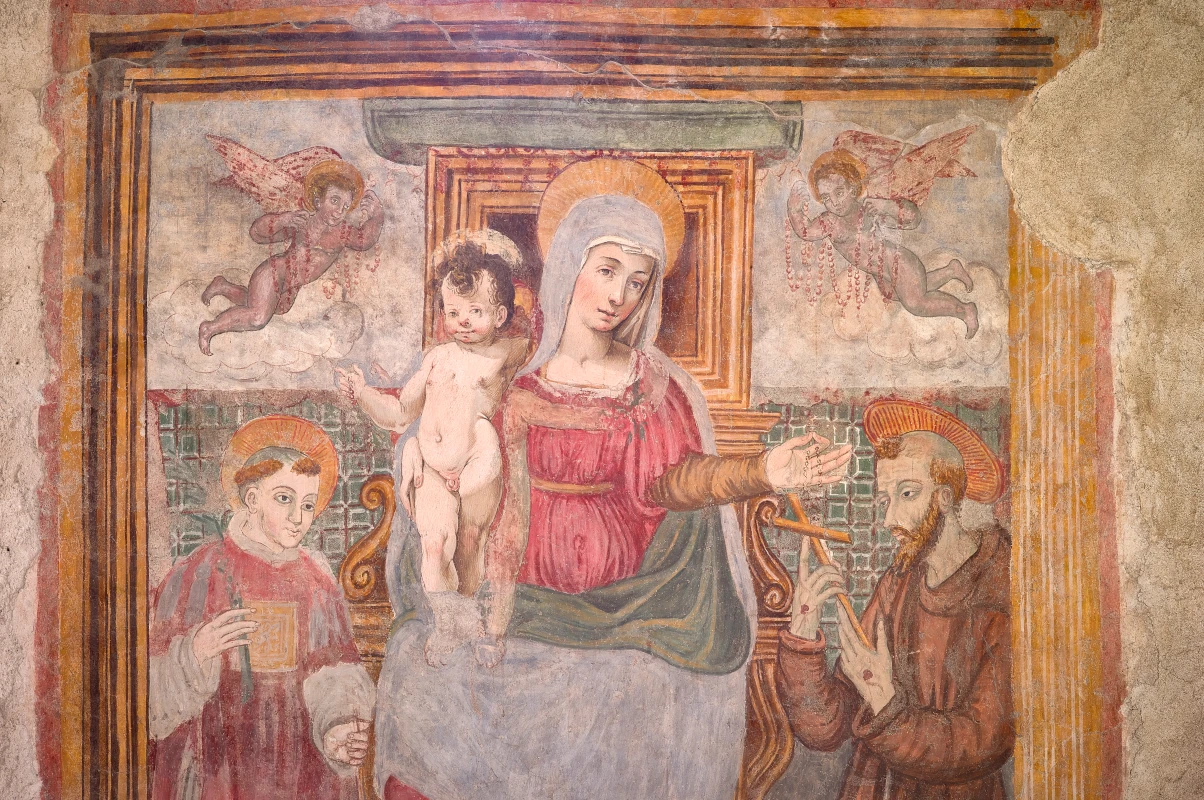
Further frescoes dating between the 15th and 16th centuries appear on the other walls of the nave, including depictions of the Madonna and Child and various saints. The traces left by different eras help piece together a story that time had gradually covered over, and that the restoration work has helped bring back into focus.
In this case, a photograph only tells part of the story. What matters is understanding how the works are set within the architecture, and why they appear today in the form they do.
From historic church to today’s cultural space
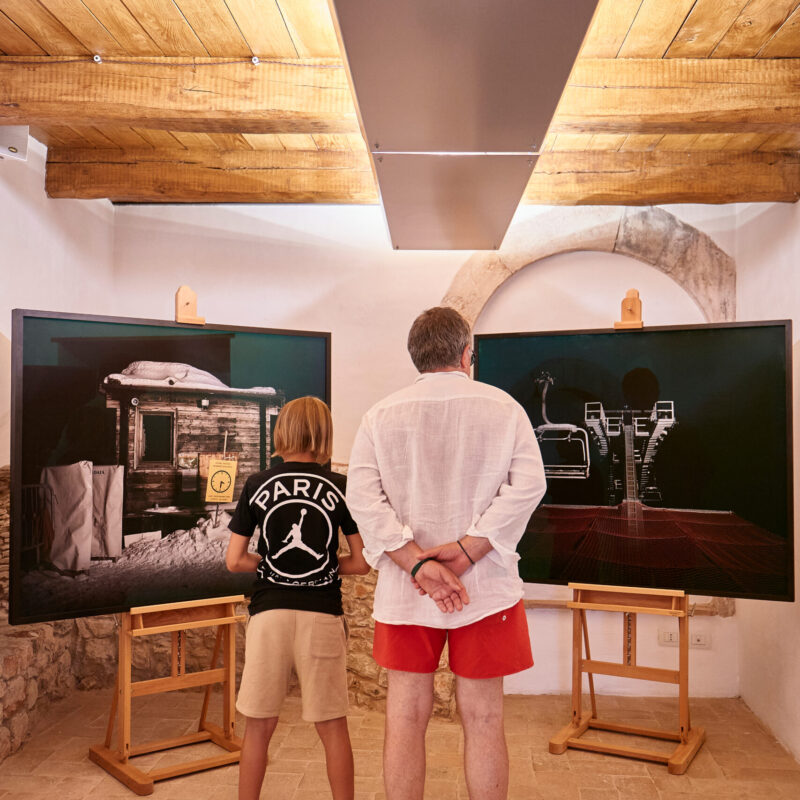
The church can be visited during the hamlet’s opening hours and is used as a cultural space, hosting concerts and other public events. Having been a place of worship and having weathered architectural changes and earthquakes, the church has once again become a space people visit.
Today, that Crucifixion is still there.
Visit Castello di Postignano and discover the Church of SS. Annunziata and the artistic heritage held within the hamlet.